
Engineering resilient, engaged, and empowered communities across the globe
Civil and environmental engineer Khalid Osman seeks to change the world through infrastructure and create a future where all communities have access to safe and reliable services.

Khalid Osman realized at a young age that he didn’t want to be a medical doctor.
Born in Kenya to Somali refugee parents, Osman immigrated with them to Portland, Oregon, in 1995. Being a doctor would enable him to help people and give back to his community.
“But I realized I can’t do needles, and I can’t do blood. So what’s the next best thing?” said Osman, an assistant professor of civil and environmental engineering at Stanford. “I grew up in neighborhoods and communities where it felt like your voices weren’t listened to. You had to live with inadequate infrastructure – you didn’t have a choice. You had to be grateful – you couldn’t think about improving what you had.”
Osman found himself drawn to civil engineering, where he felt he could help improve lives in disadvantaged communities. He approaches his work through an equity and social justice lens, striving to ensure that all communities can access basic necessities like clean air and water, sanitary conditions, and safe roads.
“You can have a great hospital, but if you don’t have a road that gets you there, what good does it do you?” he said.
Osman found a home for his community-based approach at the Stanford School of Engineering and the Stanford Doerr School of Sustainability. Since 2022, he has been applying his unique perspective to courses like CEE 145E/245E: Equitable Infrastructure Solutions and SUSTAIN 101D: Sustainable Innovations for Disaster Resilience, and has been bringing students and local partners together to discuss infrastructure issues impacting residents of cities including Houston, Texas, and Des Moines, Iowa.
Osman was recognized for his efforts with the Doerr School of Sustainability’s Excellence in Community Award in May 2026.
“His commitment to his community partnerships and the care he puts into working with them has been a huge source of inspiration and learning for my own work,” noted a student nominator. “Khalid has been an incredible mentor to so many of us, and he truly epitomizes excellence in community.”
Osman’s community-focused research efforts include projects on tap water distrust and bottled water usage in vulnerable communities. His team and collaborators work to quantify and validate the experience of residents who report that their water’s color or odor is off, and look for interventions that effectively restore trust in public infrastructure and reduce the use of expensive bottled water.
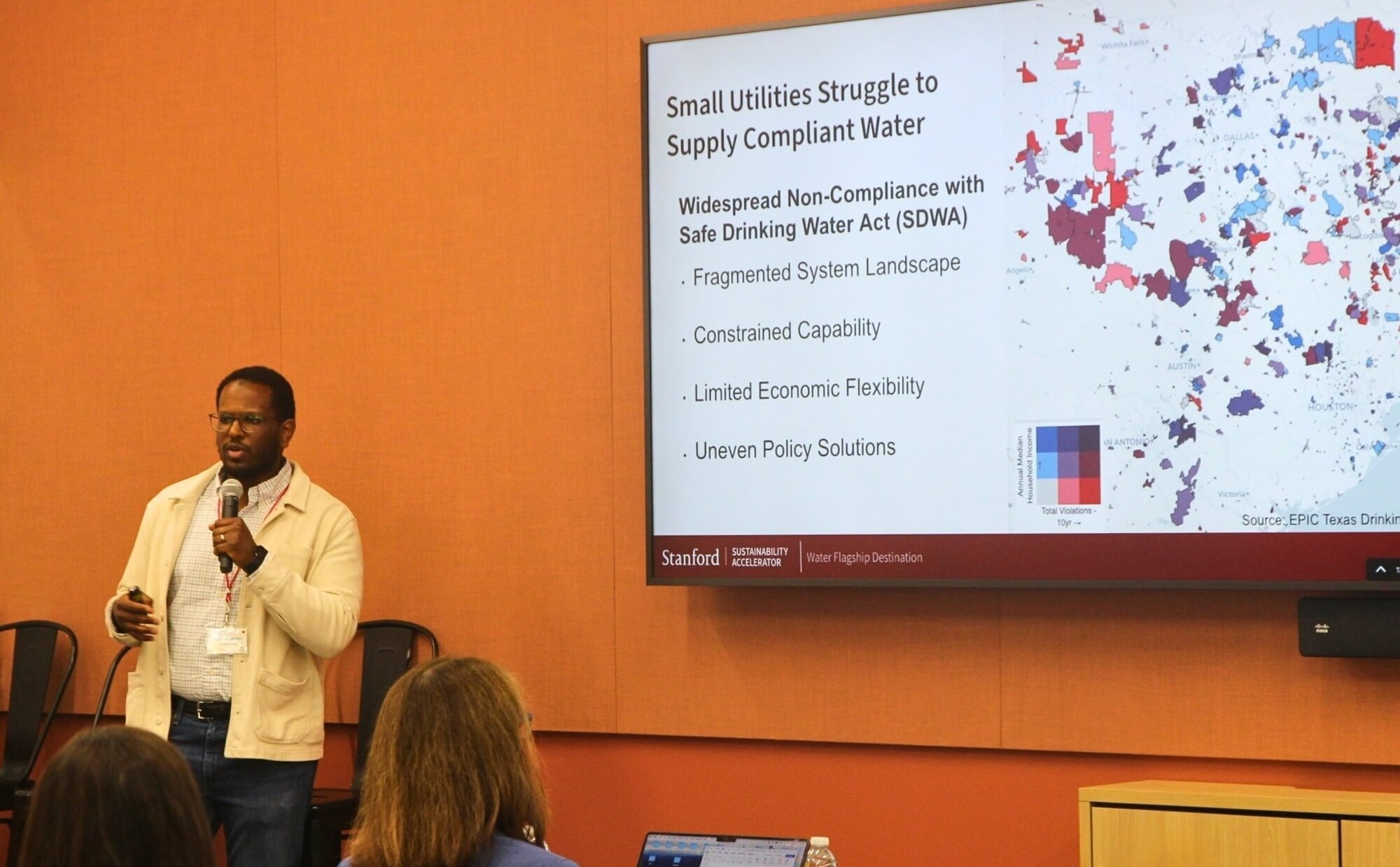
“Prof. Osman has had an extraordinary impact on my growth as a scholar, but more importantly, on the kind of researcher and community-engaged professional I am becoming,” said one nominator. “His mentorship goes far beyond traditional academic advising. He has intentionally built an environment where students are challenged to produce rigorous work while feeling supported, seen, and empowered to pursue ambitious ideas.”
Beyond guiding his students’ futures, Osman also wants to advance the practice of equity in engineering.
“I want the frameworks, models, and tools we develop in the lab that integrate equity and justice into engineering systems to become broadly adopted in the industry,” he said. “I want these to be national, global tools that improve the lives of communities.
“Change the world. That’s the primary goal.”
Explore More
-
Stanford researchers are working with the City of Santa Cruz to improve assistance programs for residents who pay their water bills indirectly through rent.
-
Khalid Osman, an assistant professor of civil and environmental engineering at Stanford University, assesses public perceptions of water infrastructure, water conservation efforts, and the management of existing infrastructure systems.
-
Stanford-led sustainability research offers tangible benefits for human health. Scientists are developing new techniques to enhance air and water quality, improve disease monitoring, mitigate risks from extreme weather and severe storms, and more.


