
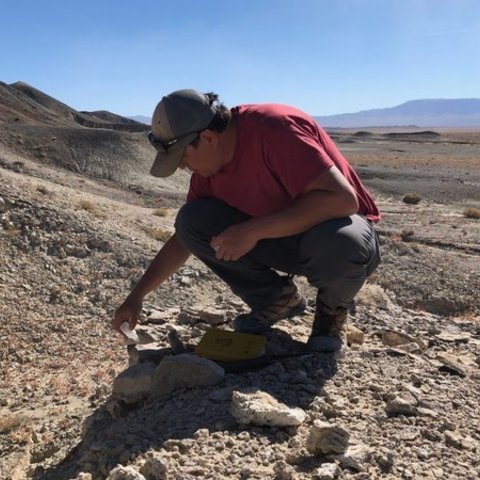
Dan Ibarra has spent over a decade of his life at Stanford. He received BS degrees in Civil & Environmental Engineering (Atmosphere/Energy) and Geological & Environmental Sciences, an MS in Geological & Environmental Sciences, and then a PhD in Earth System Science. As a postdoctoral researcher in geological sciences with a joint appointment at UC Berkeley, he studies how climate impacts the water cycle using field and laboratory measurements, as well as computer modeling. His interdisciplinary training helps him approach issues from multiple lenses and make sense of what his data reveals.
Ibarra focuses on understanding how past landscapes have responded to changes in climate throughout geologic time – and this work has implications for present-day climate change, as well. “Studying past climate gives us a roadmap for the kinds of changes we can expect in rainfall and temperature due to future changes in climate, which can inform adaptation strategies,” he said. As a recipient of the Balik Scientist Program, Ibarra has spent time in the Philippines collecting cave deposits and river samples. “As climate scientists we have no way of baselining how climate has changed in the past beyond the instrumental record, except for using the geologic record. So we study archives like tree rings, ice cores, lakes marine sediments and caves."
Ibarra is excited to share the impact of his work as he prepares to leave Stanford and begin a forthcoming assistant professorship at Brown University’s Department of Earth, Environmental and Planetary Sciences and the Institute at Brown for Environment & Society in January 2021. “A lot of people forget that everything is built on top of the bedrock. The water cycle and the biosphere and everything we can relate to is dictated by the substrate upon which it is built. I’m excited about sharing that with young people and people who aren’t as familiar with geology.”
Explore More
-
The majority of people in the United States support affordable housing, but attitudes often shift when local developments are proposed. Stanford researchers have found that negative emotional associations with the idea of affordable housing, as well as racist beliefs, contribute significantly to neighborhood-level opposition.
-
Stanford scientists simulated the local risk of damaging or nuisance-level shaking caused by hydraulic fracturing across the Eagle Ford shale formation in Texas. The results could inform a new approach to managing human-caused earthquakes.
-
A new type of flow battery that involves a liquid metal more than doubled the maximum voltage of conventional flow batteries and could lead to affordable storage of renewable power.


