
Untold stories of environmental injustice
A new anthology of environmental justice storytelling from the Environmental Justice Working Group at Stanford addresses topics including childhood lead poisoning, extreme weather events, and connection to nature.

For millennia, ferns’ deep roots have pulled nutrients from soil, allowing the resilient plants to survive despite changing conditions on Earth. The leaves of these tenacious plants, fronds, provide inspiration for members of Stanford’s Environmental Justice Working Group. The group recently celebrated the launch of its second volume of Fronds: A Stanford Anthology of Environmental Justice Storytelling, under an oak tree at the O’Donohue Family Stanford Educational Farm.
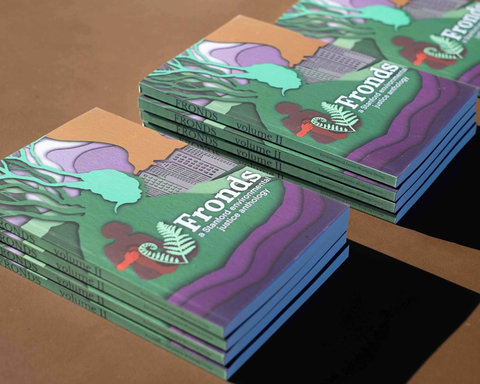
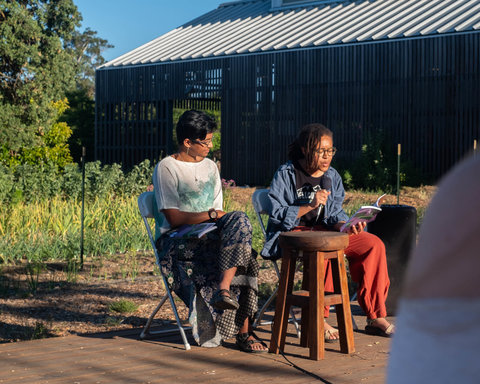
At the May 29 event, anthology contributors shared their experiences of environmental injustice and what a just future looks like to them. The volume’s works, which range from illustrations to poetry, address topics such as childhood lead poisoning, extreme weather events, the affordable housing crisis, Indigenous rituals, and connection to nature.
“Our people had different ways of tending to the land that had given us life,” student Carol Ileana Aguilar read from a poem she had written about the colonization of Indigenous and Native communities. “But in smoke, fumes, and flames our people’s blood was shed.”
Members of the working group expressed hope that the anthology might empower diverse voices to share stories and embed environmental justice principles in Stanford’s education and research.
“It’s important to capture these stories because these aren’t stories that have been told,” said Tanvi Dutta Gupta, BS Biology ’23, MS Earth Systems ’24, who served as managing editor of the anthology with Aiyana Washington, ’24, while both were students in the Stanford Doerr School of Sustainability’s Earth Systems Program. (Dutta Gupta graduated this month with a master’s degree from the program, while Washington has earned a bachelor’s degree and will return in the fall for her master’s.) “Environmental injustice as we address it in Fronds is a product of the many ways that dominant powers have exerted violence on the marginalized,” Dutta Gupta said.
In the anthology, Dutta Gupta and Washington compare a fern’s resilience to the work of Stanford’s Environmental Justice Working Group, which collaborates with groups across campus and environmental justice organizations around the country.
“The movement toward societal growth often goes unnoticed, under the surface, until it begins to sprout and finally, blooms,” Dutta Gupta and Washington write. “The work that reaches upwards now is also our roots in the making, our histories in the becoming.”
The Fronds Anthology project is supported by Student Projects for Intellectual Community Enhancement (SPICE) and the Stanford Doerr School of Sustainability.
Explore More
-
Climate change could make historically rare tropical cyclones more common in Southern California, significantly expanding landslide risk across the region by 2050.
-
Gross Domestic Product, the standard metric for measuring national economies, doesn’t account for the valuable services provided by nature. A new approach could help fill the gap.
-
Recent rapid growth in climate philanthropy risks redundancy, waste, and friendly fire, according to Laurence Tubiana of the European Climate Foundation and Christie Ulman of the California-based Sequoia Climate Fund. (Source: Stanford Social Innovation Review)


